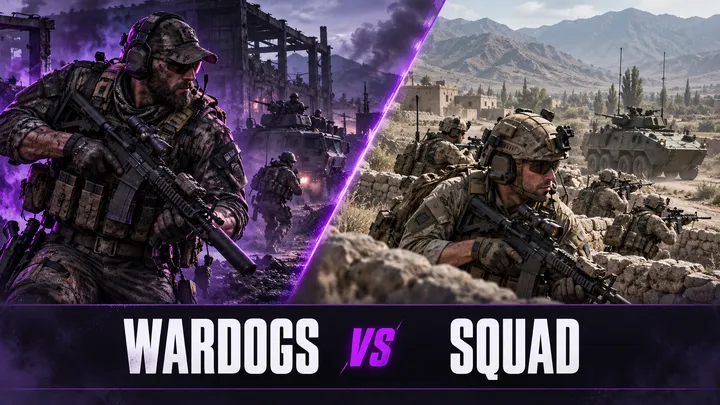
WARDOGS vs Squad: Which Tactical Shooter Fits You?
You have played Squad, or you have watched enough of it to know what you are getting into.
Now WARDOGS is live in Steam Early Access, getting compared to Squad in nearly every trailer reaction and Steam review.
The two games share a genre and not much else.
Squad is built on chain of command and patience.
WARDOGS is built on cash, risk and a third team that is always watching your fight.
Here is what actually changes when you move from one to the other.
Table of Contents
- WARDOGS vs Squad at a Glance
- What Is WARDOGS?
- What Is Squad?
- Two Teams vs Three Teams
- Squad Leaders vs No Chain of Command
- Classes vs Buy-Your-Loadout
- Ticket Timers vs Persistent Cash
- Map Scale and the Control Zone
- Vehicles and Combined Arms
- Price, Platforms and Access
- Which One Should You Play?
- Key Takeaways
- FAQ
WARDOGS vs Squad at a Glance
| WARDOGS | Squad | |
|---|---|---|
| Teams per match | Three | Two |
| Max players | Up to 100 | Up to 100 (50v50) |
| Squad size | No hard cap on a group | Capped at 9 per squad |
| Classes | None. Gear bought per life sets your role | Fixed roles per squad slot |
| Economy | Persistent cash, starts at $10,000 | No currency. Death costs time, not money |
| Command structure | None. Incentive-driven | Squad leader hierarchy |
| Map size | 256 km² map, 2x2 km Control Zone | Up to roughly 16 km², fully playable |
| Price | $39.99 (Early Access) | $39.99 |
| Platform | Windows PC via Steam | Windows PC via Steam |
| Status | Steam Early Access since Sep 10, 2026 | Full release since Sep 23, 2020 |
The short version: if you like Squad for its command structure and slow, deliberate holds, WARDOGS will feel looser and more chaotic.
If you want large-scale infantry and vehicle combat without the radio discipline, WARDOGS is the easier way in.
What Is WARDOGS?
WARDOGS is BULKHEAD’s tactical FPS, published by Team17, currently in Steam Early Access. For the full rundown of the game itself, see what WARDOGS is.
Up to 100 players split across three teams fight over a single randomized Control Zone.
Bulkhead has said the mode takes its structure from King of the Hill, the long-running Arma 3 community mod, covered in the WARDOGS King of the Hill mode guide.
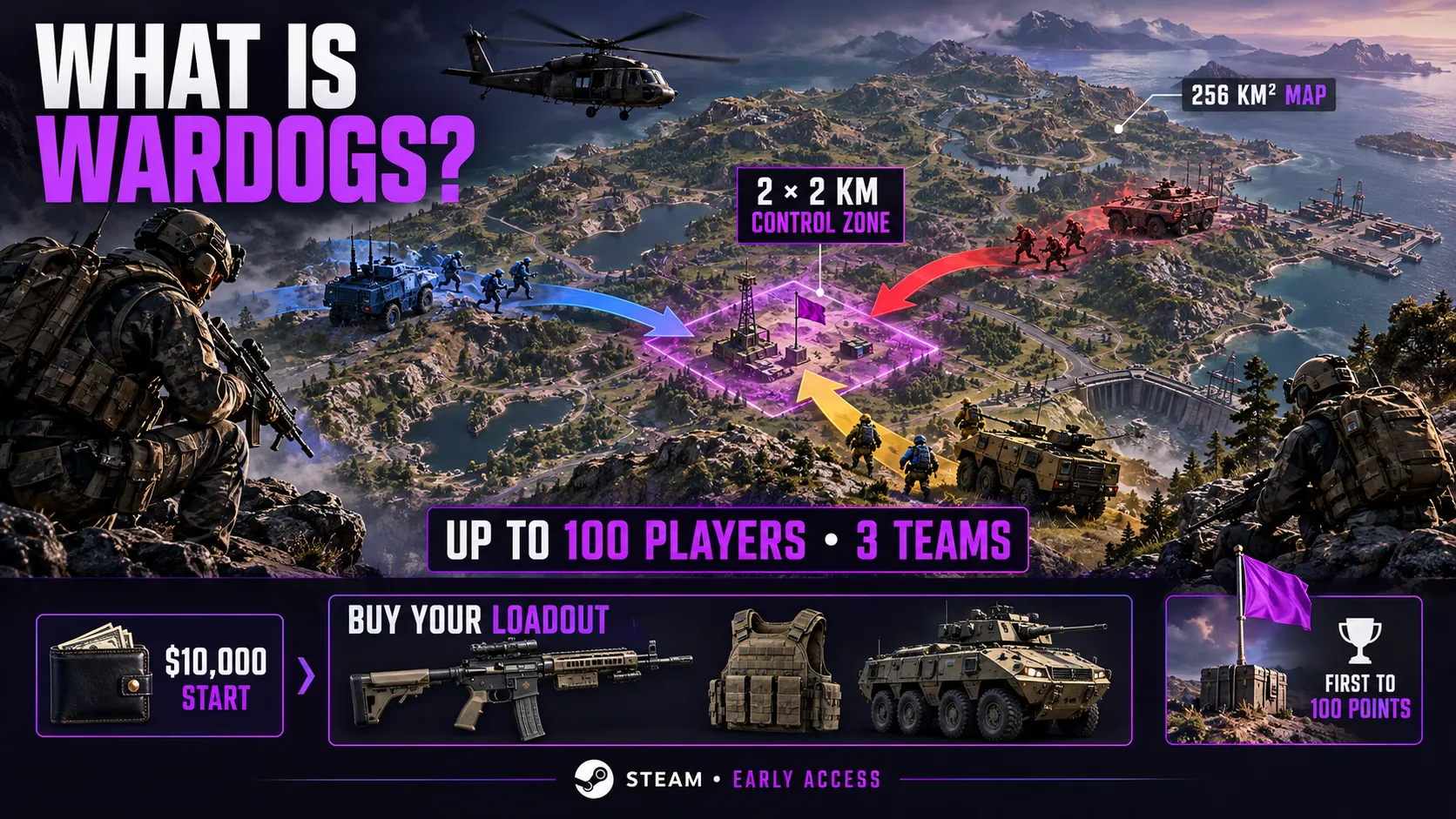
The zone measures 2x2 kilometers and sits inside a much larger 256 square kilometer map, so the fight moves rather than staying fixed to one corner of the level.
Whichever team holds the most players inside the zone earns points.
The first team to 100 points wins.
There are no classes.
Every player starts with $10,000 and spends it on weapons, gear and vehicles before each life.
That balance persists between matches and does not reset on death.
A bad life with expensive gear is a real financial hit, not just a respawn timer.
What Is Squad?
Squad is Offworld Industries’ realism-focused military shooter, fully released on Steam in September 2020 after five years in Early Access.
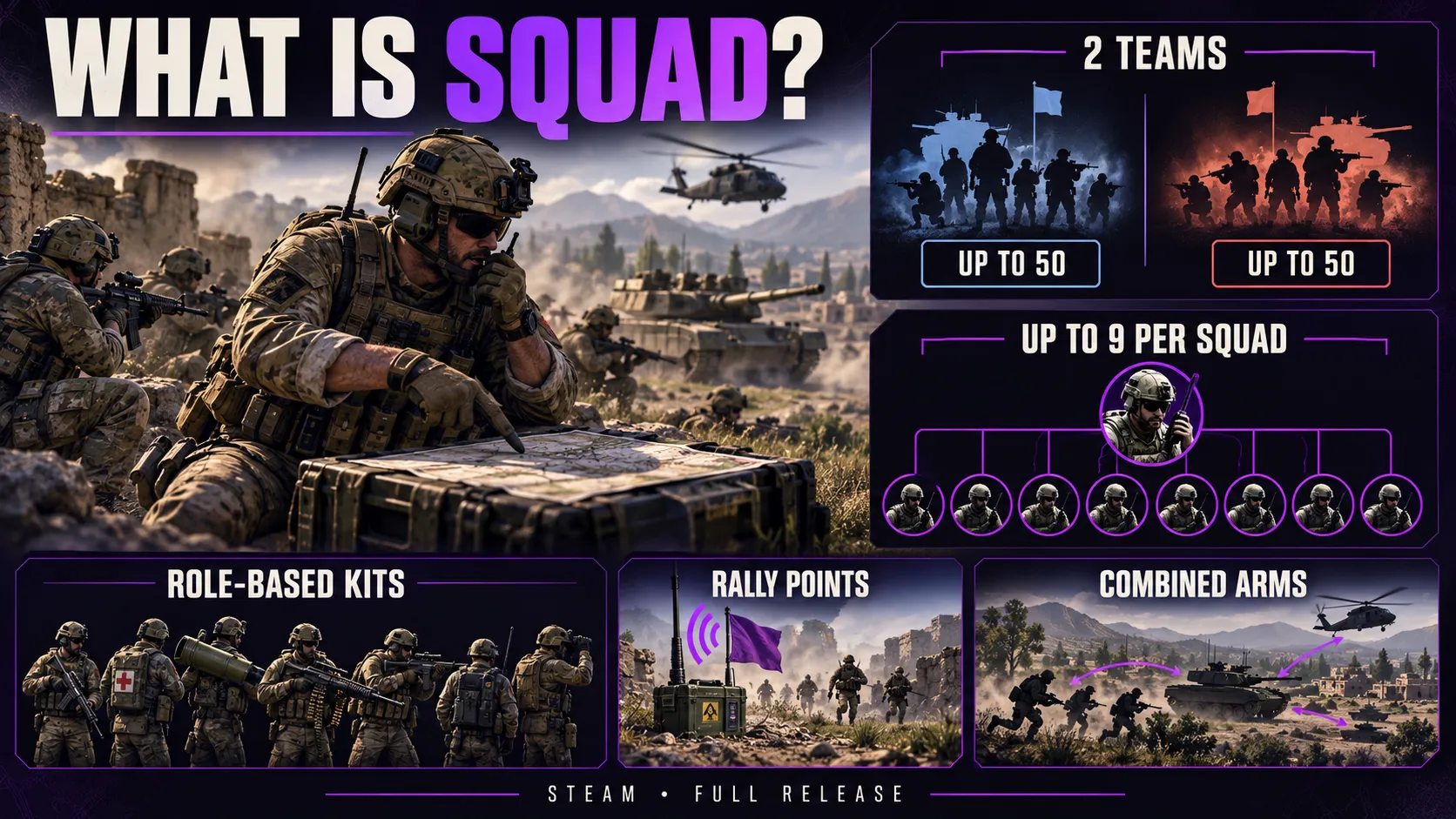
Matches put two teams of up to 50 players against each other.
Each side splits into squads of up to 9 people, each led by a squad leader.
Squad leaders place rally points for their squad to spawn on, call for vehicles, and coordinate with other squad leaders through a command channel.
Kit is tied to role.
Take the marksman slot in your squad, or you do not get the marksman rifle.
Maps run as large as roughly 16 square kilometers and are combined-arms from the start, with infantry, armor and aircraft sharing the same space across seven distinct game modes.
Two Teams vs Three Teams
This is the single biggest structural difference between the two games, and it changes almost everything downstream of it.
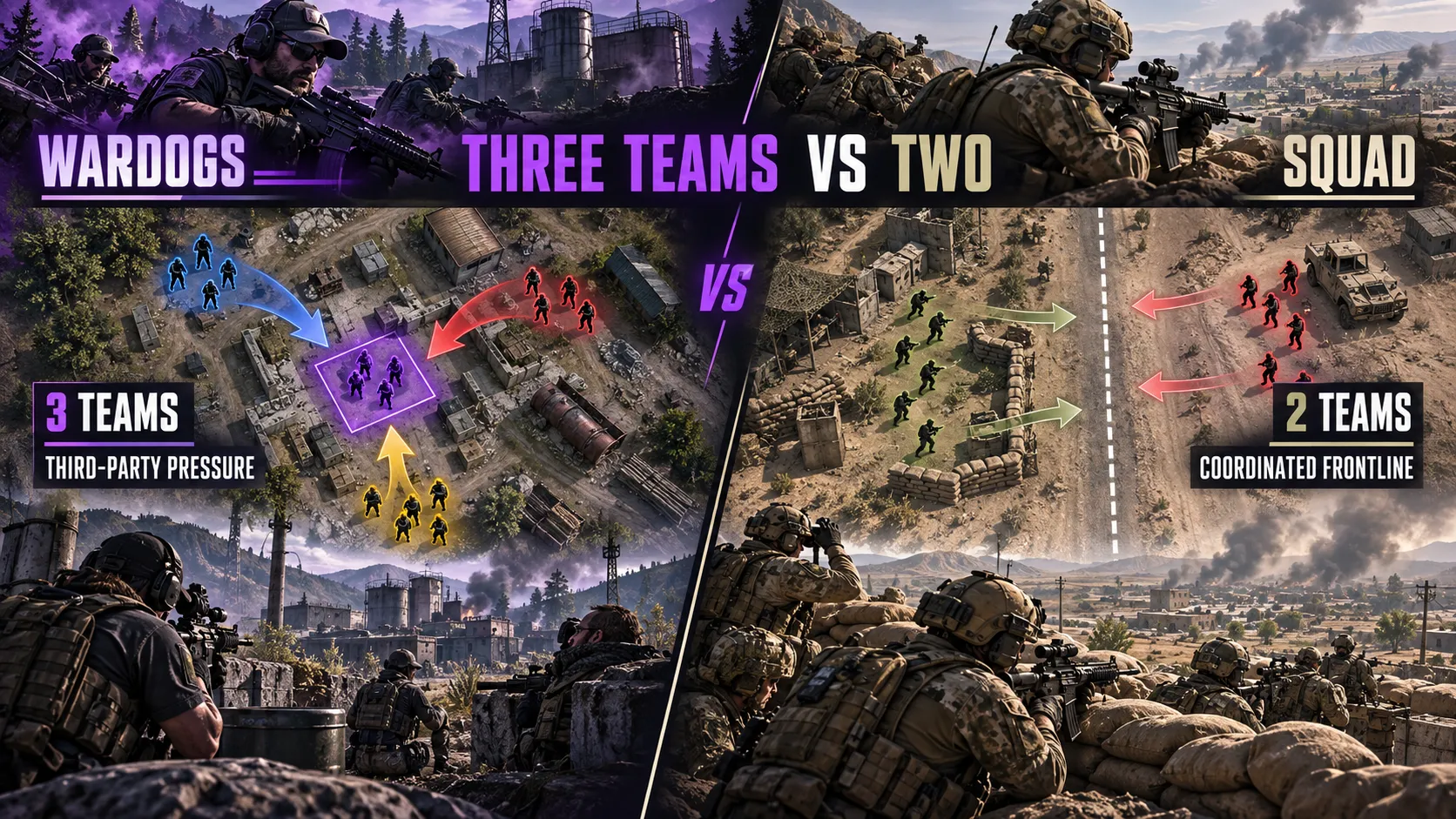
Squad, like most large-scale military shooters, puts two sides on a map.
That produces a front line: a direction called forward, a direction called back, and both teams agree on which is which.
Holding ground tends to be easier than taking it.
The team that secures an early advantage often keeps it.
WARDOGS removes the two-sided front line entirely by putting three teams on one Control Zone.
Committing your team’s strength against one rival exposes you to the second rival at the same time.
The team currently winning is, by design, the team both other teams have a reason to attack.
Verdict: Squad rewards patient, coordinated holds. WARDOGS punishes exactly that instinct, because sitting still and consolidating invites a third party to take the zone out from under you.
Squad Leaders vs No Chain of Command
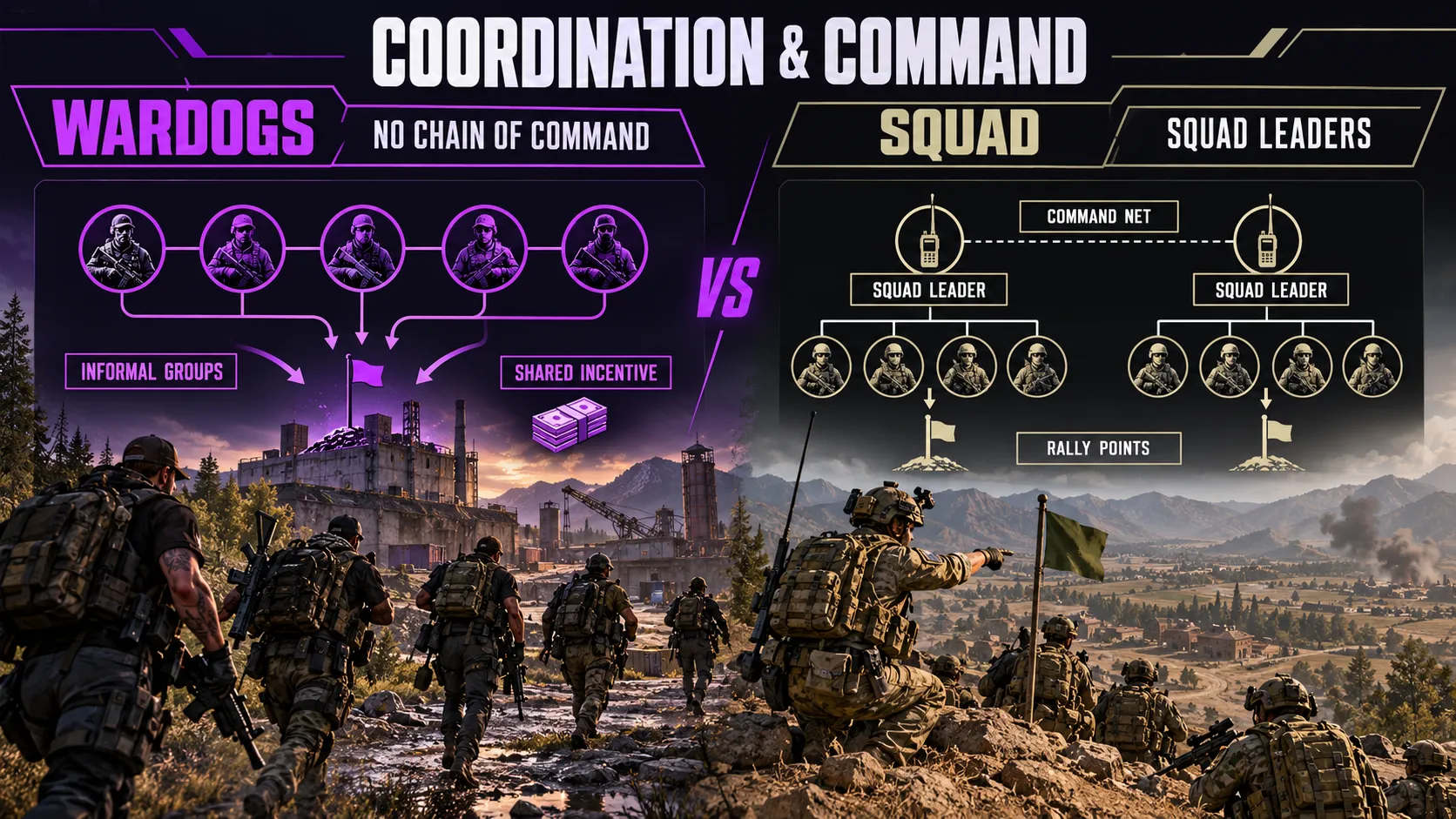
Squad’s chain of command is not a side system.
It is the game.
A squad leader deciding where to place a rally point is a decision four to eight other players live inside of.
Command Net lets squad leaders talk to each other and plan across the whole team, separate from the local and squad voice channels everyone else uses.
WARDOGS has no equivalent leadership role.
Coordination still happens, but it comes from shared incentive rather than a hierarchy.
Moving toward the Control Zone pays cash, and going in alone against two other teams is expensive, so grouping up is the rational choice even without anyone giving orders.
Community guides for WARDOGS describe informal squads that can grow past Squad’s 9-player cap, since there is no equivalent structural limit forcing a split.
Verdict: if the appeal of Squad is genuinely being a squad leader, that role does not exist in WARDOGS. If the appeal was just fighting alongside a coordinated group, WARDOGS gets you there without the responsibility.
Classes vs Buy-Your-Loadout
Squad locks weapons and equipment to specific slots inside a squad.
Want the anti-tank launcher, the medic bag or the marksman rifle?
Someone in your squad has to take that slot, and only one person can hold it at a time.
This keeps squads balanced but means your loadout is decided partly by whoever got to the role first.
WARDOGS skips fixed classes altogether.
Before every life, you buy your own loadout from what you can afford: weapons, armor, utility, vehicles.
What you buy is your role for that life, and there is no obligation to repeat the same choice next time.
Player guides describe roughly six loose playstyles the game tracks progression against - infantry, recon, support, medic, driver and pilot, laid out in the WARDOGS classes guide.
These are progression ladders, not locked slots that block a teammate from also playing them.
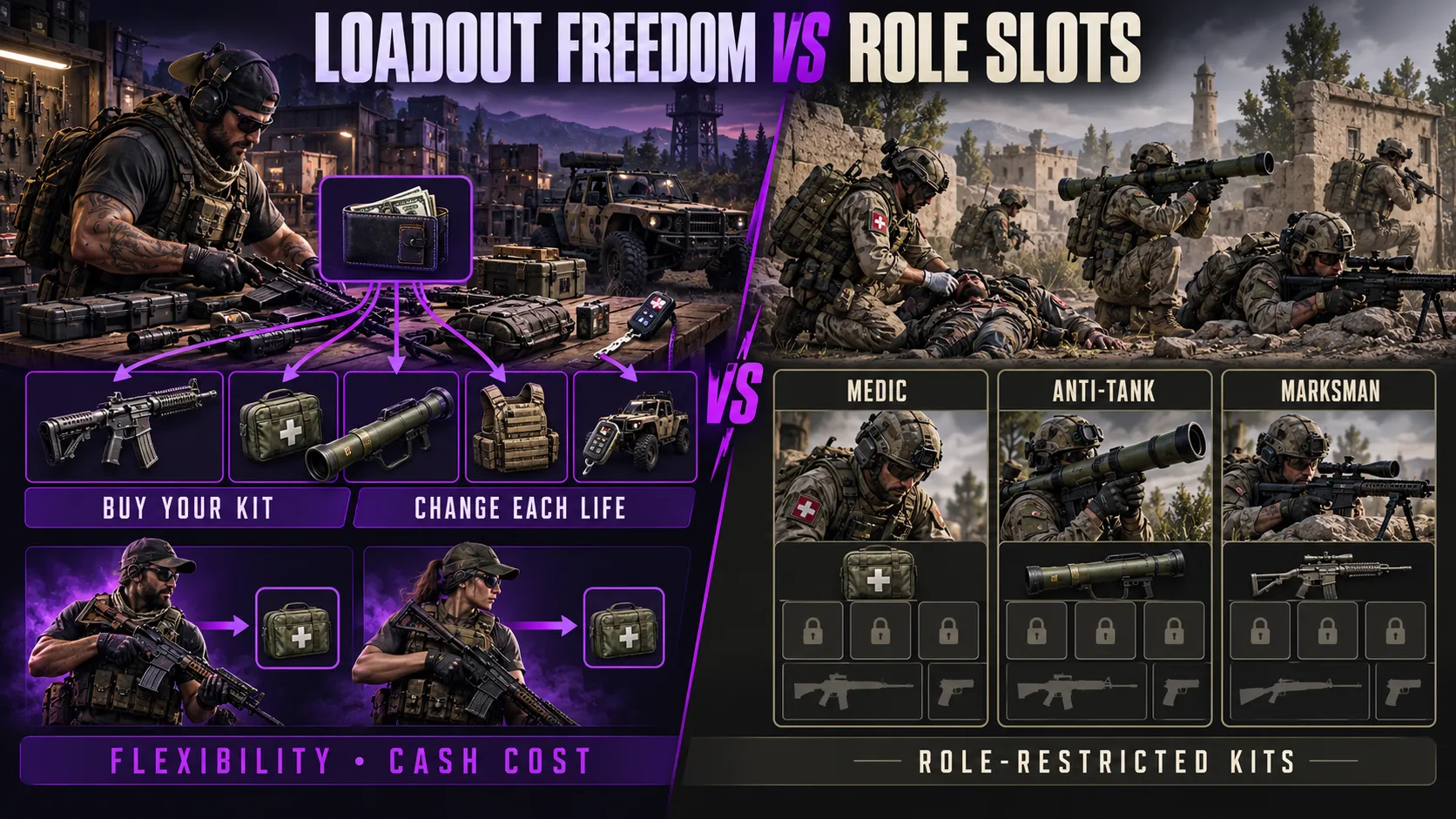
Verdict: Squad’s classes create built-in team balance at the cost of flexibility. WARDOGS trades that balance for freedom, backed by a cash cost that keeps players from spamming the most expensive gear every life.
Ticket Timers vs Persistent Cash
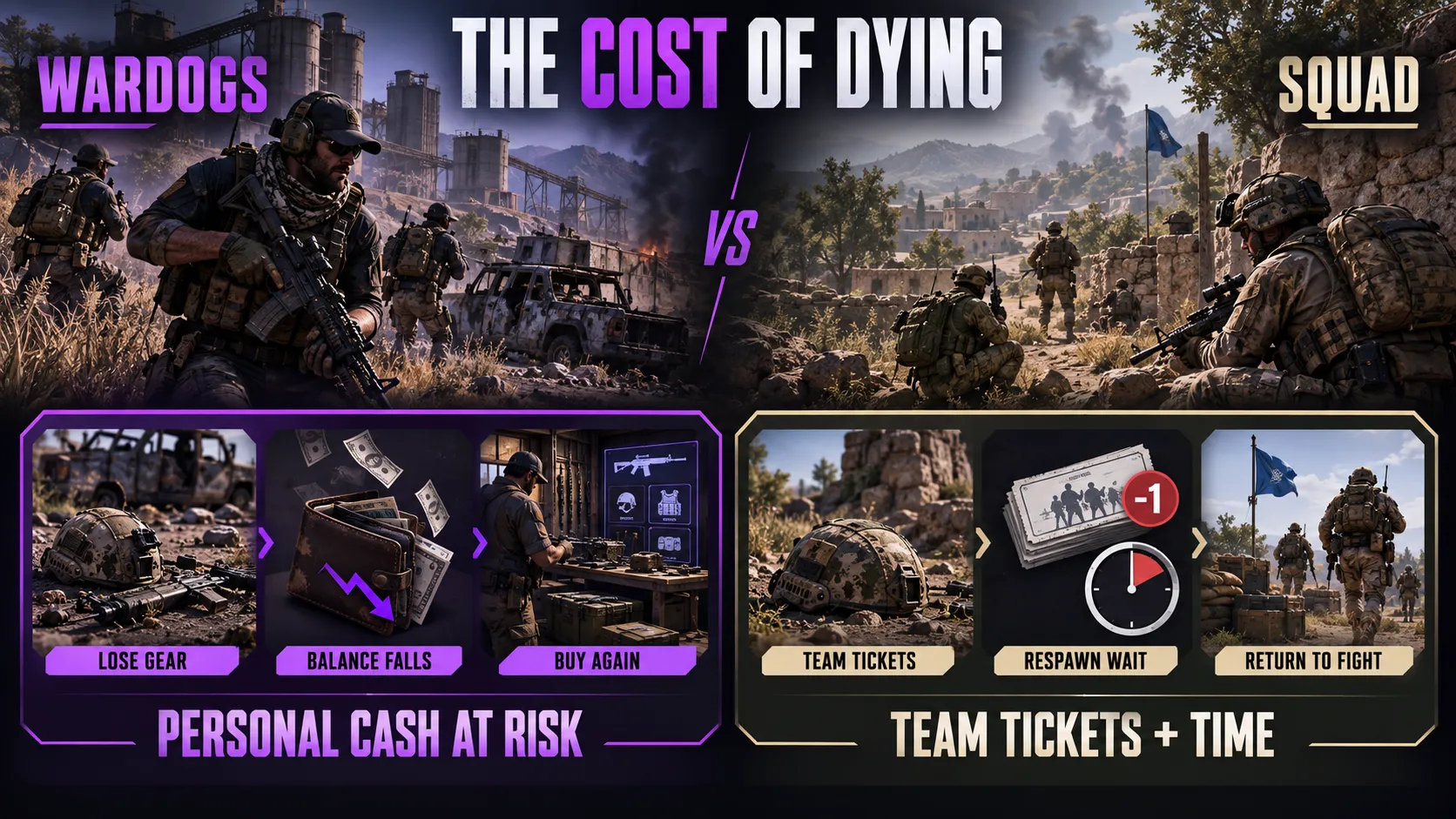
Squad’s cost for dying is time.
Each match runs on a shared ticket pool per team, and death sends you back to a respawn timer and, often, a walk from the nearest rally point.
The kit you spawn with next is the same kit you would have had anyway, since nothing is purchased.
WARDOGS makes death a financial event.
Whatever gear you were carrying when you died is gone, and your account balance does not refill between lives.
Go out with a fully kitted loadout and a vehicle, and that is real money you will not have for your next purchase, as explained in the WARDOGS cash economy guide.
This single change reshapes how people play.
In Squad, the pressure is on patience: don’t waste your team’s tickets.
In WARDOGS, the pressure is on judgment: don’t risk gear you can’t afford to lose.
Cheap loadouts get thrown around carelessly.
Expensive ones get played cautiously, because losing one is a real setback, not a reset.
Map Scale and the Control Zone
On paper, WARDOGS has the bigger map: 256 square kilometers against Squad’s roughly 16.
In practice, the comparison is not that simple.
Squad’s entire map is playable ground.
Combined-arms fighting, from infantry skirmishes to armor pushes, is spread across the whole space, and the front line can be anywhere the two teams meet.
WARDOGS puts the entire fight inside a randomized 2x2 kilometer Control Zone.
That is roughly one sixty-fourth of the total map.
The rest of the map exists as approach routes and space to maneuver in or around, not as ground that gets fought over directly every match.
A WARDOGS match is, in effect, a small fight inside a very large sandbox, laid out fully in the WARDOGS map guide.
A Squad match uses most of its map as active battlefield.
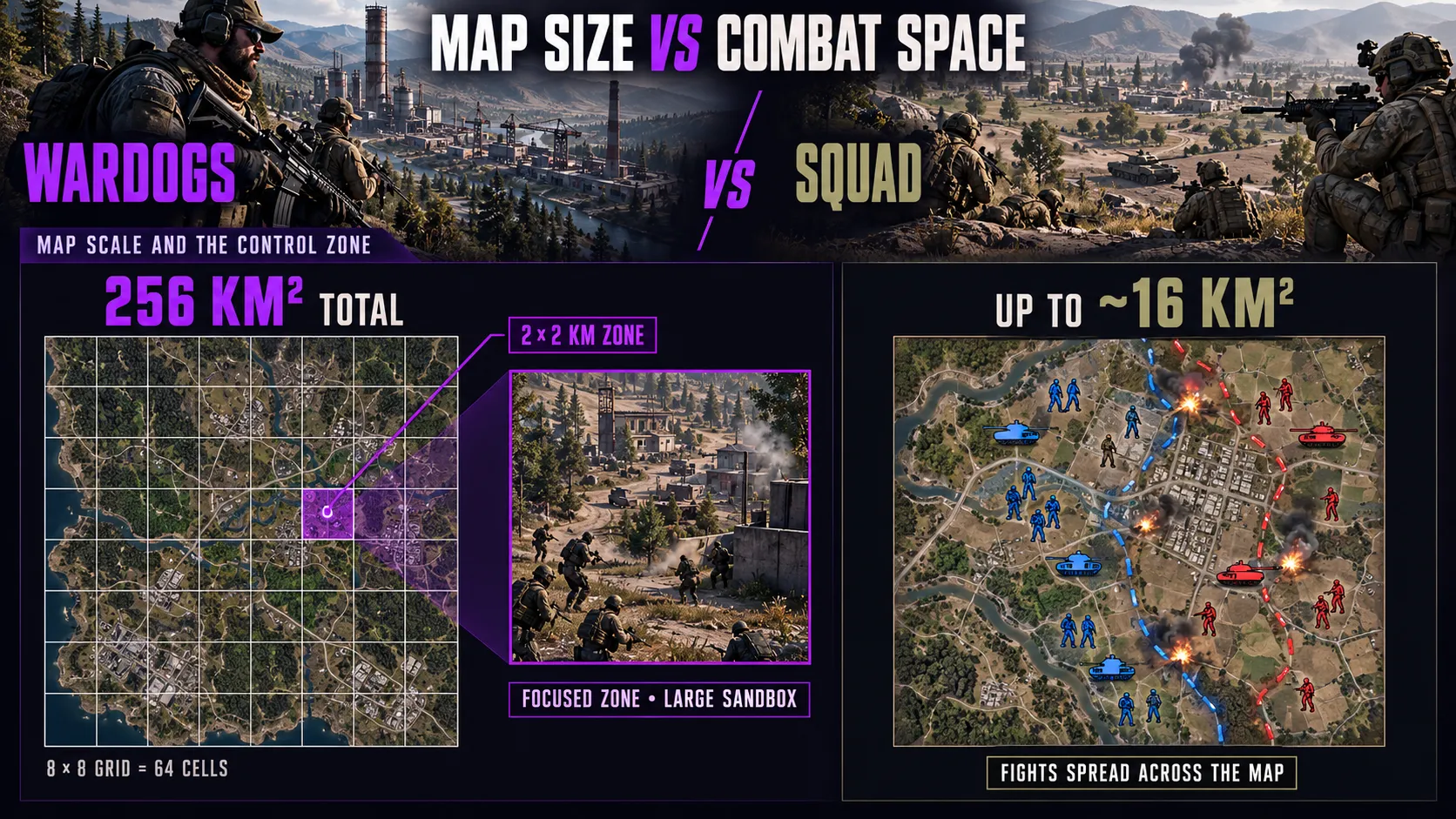
Verdict: Squad’s map size is closer to its actual combat footprint. WARDOGS’ bigger number describes total space, not the size of any single engagement.
Vehicles and Combined Arms
Both games treat vehicles as central, not optional.
Squad ties vehicle access to the squad and command structure.
A squad leader or vehicle crew role claims a vehicle, and using it well depends on coordinating with infantry on the ground.
Assets range from technicals and IFVs up to tanks and helicopters, depending on the faction and map.
WARDOGS buys vehicles the same way it buys everything else: with cash, before a life, no different from buying a rifle.
Bulkhead has stated plans to expand the vehicle roster further during Early Access, including fighter jets, on top of the ground and air vehicles already in the game at launch.
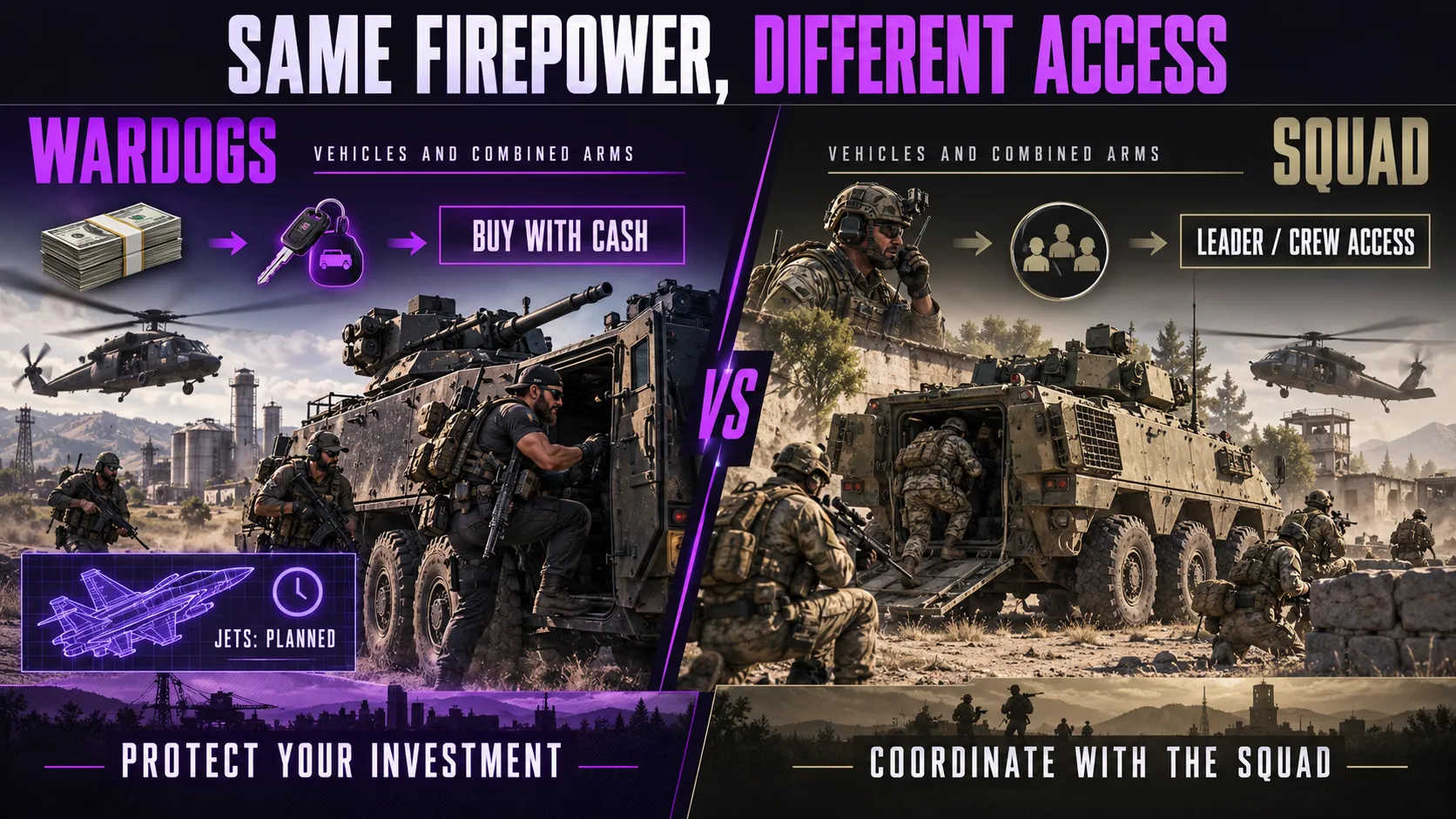
Verdict: the vehicles themselves serve a similar combined-arms purpose in both games. The difference is access. Squad’s vehicles are earned through a role. WARDOGS’ vehicles are earned through cash you have to protect.
Price, Platforms and Access
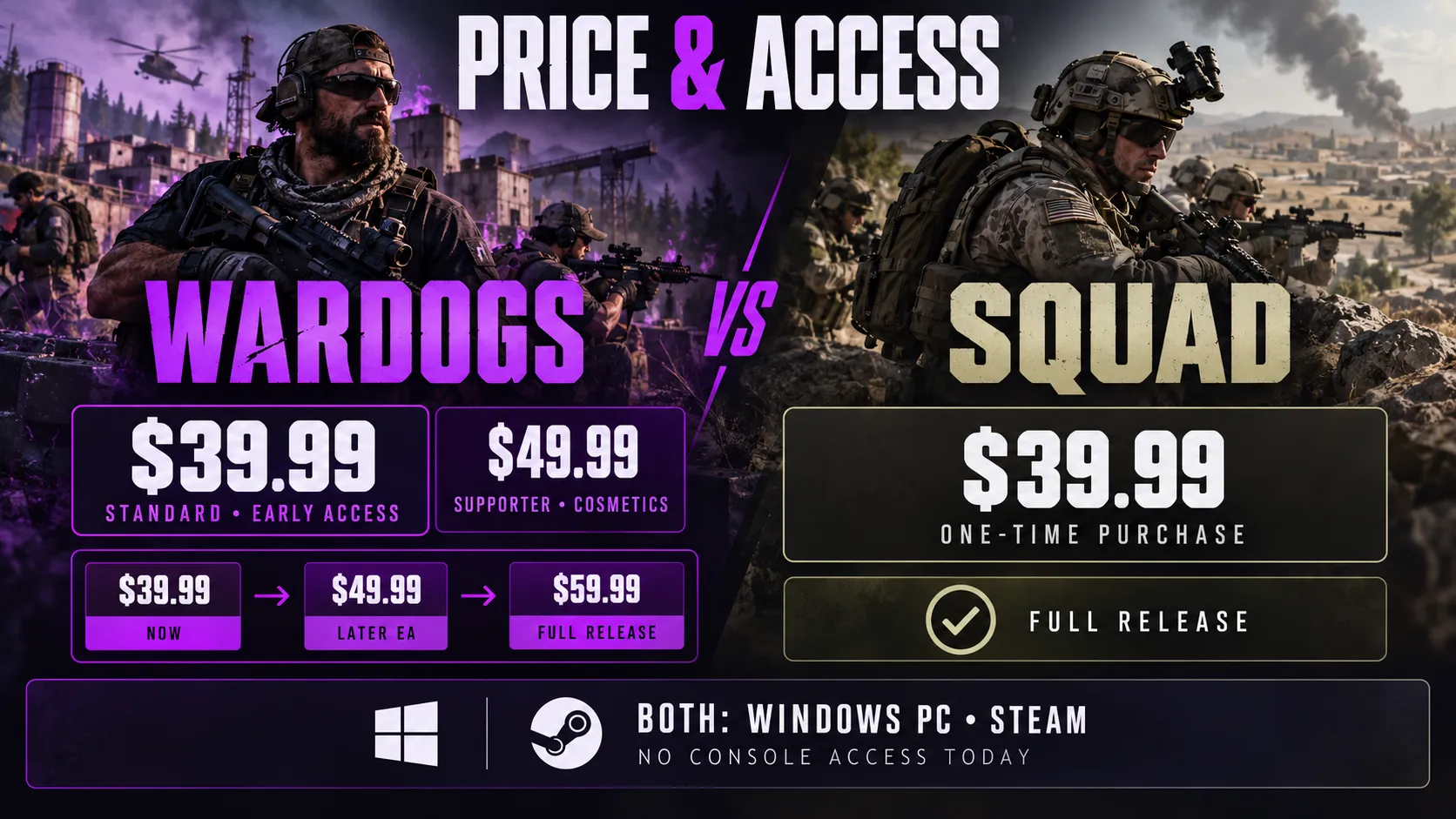
Both games are premium, one-time purchases rather than free-to-play.
Squad has sat at $39.99 for years since its 2020 release.
WARDOGS launched into Steam Early Access on September 10, 2026, also at $39.99.
Bulkhead has confirmed a staged price increase to $49.99 later in Early Access and $59.99 at full release, and a separate cosmetic-only Supporter Edition at $49.99, covered in the WARDOGS Early Access guide.
Neither game currently supports consoles.
Both are Windows PC titles distributed through Steam, so there is no crossplay consideration to factor in either way.
Verdict: price is a non-factor between them right now. The decision comes down to which loop you actually want to play, not which one costs less.
Which One Should You Play?
If you want the closest thing to a military coordination sim, with a real chain of command, rally points and roles that matter, Squad is still the more complete version of that experience, five years of updates deep.
If two-team front lines have started to feel predictable, or you want infantry and vehicle combat without needing a squad leader’s permission to move, WARDOGS’ three-team Control Zone offers a genuinely different shape of match, even if it is rougher around the edges as an Early Access title.
Playing both is a reasonable answer too.
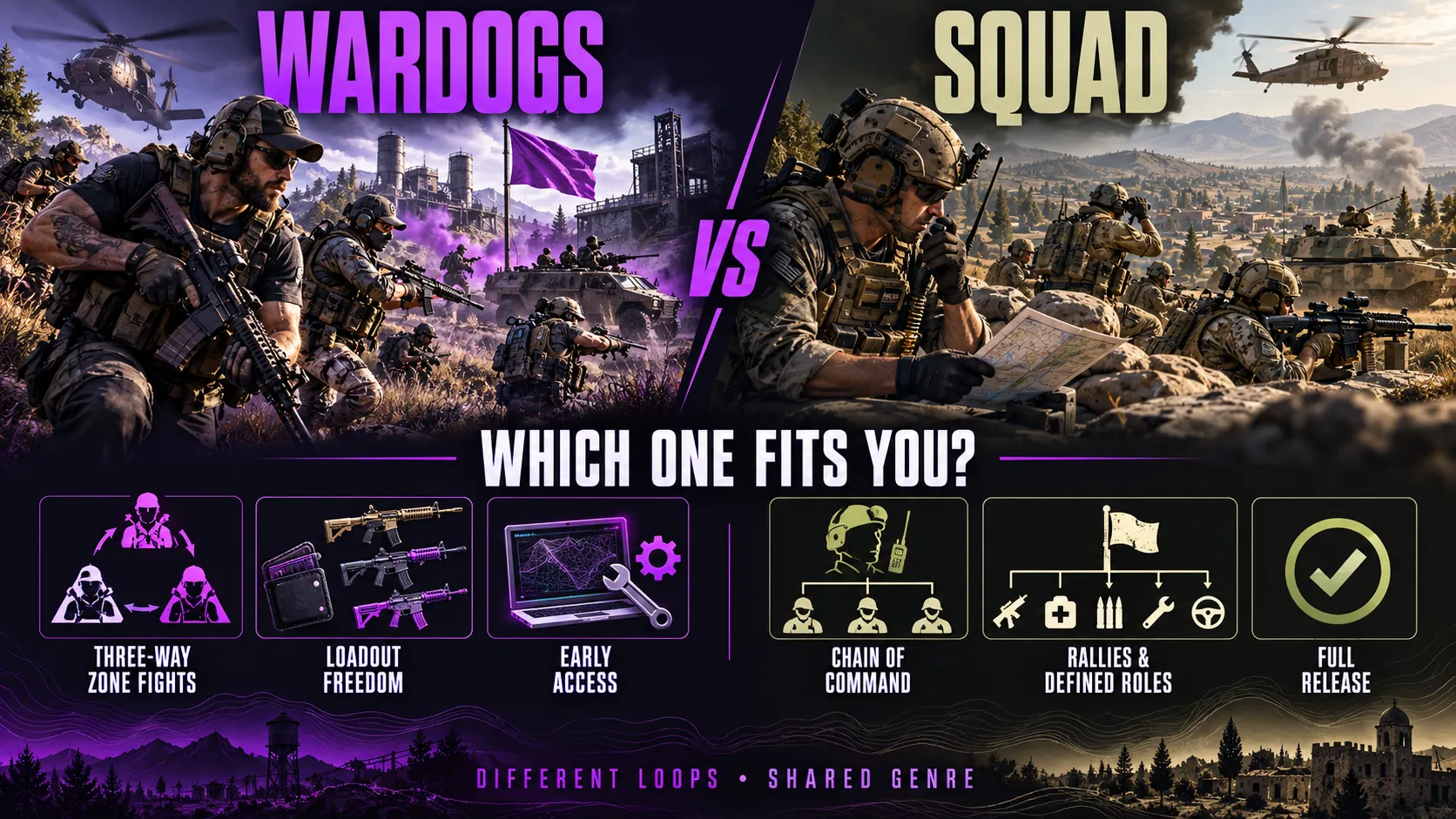
They are close enough in genre to share an audience, and different enough in structure that neither makes the other redundant. For how WARDOGS stacks up against other large-scale shooters, see the WARDOGS vs Battlefield comparison.
Key Takeaways
- WARDOGS splits 100 players into three teams fighting one Control Zone. Squad splits 100 players into two teams of 50.
- Squad runs on squad leaders, rally points and locked class roles. WARDOGS has no chain of command and no fixed classes.
- Squad’s cost for dying is time. WARDOGS’ cost for dying is persistent cash that does not refill between lives.
- WARDOGS’ 256 km² map holds a small, randomized 2x2 km fight. Squad’s roughly 16 km² map is combat ground almost everywhere.
- Both cost $39.99 on Windows PC via Steam. WARDOGS is in Early Access; Squad has been fully released since 2020.
FAQ
Is WARDOGS similar to Squad?
Only at a distance.
Both are large-scale tactical FPS titles with vehicles, base building and proximity voice chat.
The core structure is different: Squad is two 50-player teams built around squad leaders and rally points, while WARDOGS is three 100-player teams fighting over one Control Zone with no fixed squad roles.
How many players are in a WARDOGS match compared to Squad?
Both cap out at up to 100 players per match.
Squad splits that into two teams of 50.
WARDOGS splits it into three teams competing for the same objective at once.
Does WARDOGS have squad leaders like Squad?
Not in the same sense.
Squad’s structure runs through squad leaders who place rally points and manage a 9-player squad.
WARDOGS has no equivalent leadership role.
Coordination comes from shared incentives, such as cash rewards for holding the Control Zone, rather than a command hierarchy.
What is the WARDOGS cash economy and how is it different from Squad?
In WARDOGS, every player starts with $10,000 and buys weapons, gear and vehicles before each life.
That cash persists between matches and does not refill on death, so losing an expensive loadout is a real setback.
Squad has no equivalent currency.
Death there costs a respawn timer and a walk back to the fight, not money.
Is WARDOGS harder to learn than Squad?
Squad has the steeper initial learning curve because of its command layers, radio discipline and squad-leader responsibilities.
WARDOGS drops the chain of command but adds a three-team objective fight and a loadout economy to manage, so the learning curve shifts rather than disappears.
Does WARDOGS have vehicles like Squad?
Yes.
Both games build combined-arms combat around vehicles alongside infantry.
Squad’s vehicles are unlocked and crewed through the squad and command structure.
WARDOGS vehicles are bought directly with in-match cash, the same as any other piece of gear.
Is WARDOGS free or does it cost money like Squad?
Neither is free.
Squad is a one-time purchase at $39.99.
WARDOGS launched into Steam Early Access at $39.99 as well, with Bulkhead confirming the price will rise in stages to $49.99 later in Early Access and $59.99 at full release.
What platforms is WARDOGS available on compared to Squad?
Both are Windows PC titles distributed through Steam.
WARDOGS has no confirmed console release at this stage.
Squad remains PC-only as well, several years after its full release.
Does WARDOGS have classes like Squad?
Squad gates kit by role inside a squad, such as the marksman or medic slot.
WARDOGS has no fixed classes.
Whatever you buy before a life determines your role for that life, and progression is tracked separately across roughly six playstyles rather than locked classes.
Is WARDOGS still in Early Access?
Yes.
WARDOGS entered Steam Early Access on September 10, 2026, and Bulkhead has said it expects the Early Access period to run one to two years while it adds maps, vehicle types and progression systems.
Which game has bigger maps, WARDOGS or Squad?
WARDOGS technically has more open space, with a 256 square kilometer map per match, though only a randomized 2x2 kilometer Control Zone is actively contested at once.
Squad’s maps run up to roughly 16 square kilometers, and combat is spread across the whole map rather than funneled into one zone.